Before writing the screenplay for Wind, I have to clarify my thoughts on the ideas and technologies I want to present, and so I share the sketches of these with you in this post. I’m making Wind as a final target practice for visual effects, before I tackle a feature film set in a solarpunk future, without central governments, politicians, or capitalism. Help me make it with a donation via PayPal (preferred as other platforms use it but still deduct fees). Or pledge continuous support through Patreon, Ko-Fi, or LiberaPay. For updates on this and other films, follow this blog by e-mail or via RSS or find me on Mastodon.
Daily updates: 2,460/2,750 (3 days left) My first goal is $2,000 (which I’ve met!), to cover the basic costs of production. Stretch goals are $750 for vfx accesories, and 500 for on-location set and prop constructions, and practical effects.
Note: If the PayPal campaign widget below
appears broken please use this direct link.
Overview
This is a long read, so I broke it into sections, starting with the concept of a cosmopolitan village, and then a vision for direct democracy and the justice system. I also talk of labour in a non-capitalist world, and healthcare. I discuss the hardware that will enable this universe to flourish, including open-source communication, factory-level 3D printer, buscycle, pedal-tractor, food processor, and biophotovaltic solar panels.
In summary, I think clean energy without social justice is just greenwashing. What’s the point of EVs and solar panels when inequality and poverty continue? Some people think it is solarpunk because Africa is turning to solar panels, or because Pakistan is having a solar revolution, but both places are consumers of the panels, which are most likely manufactured by profit-seeking companies. I fear we’ll eventually run into the same problems we have today, where a few companies control all the clean energy and, in the name of growth, enshittification will happen and the environment will still suffer. A reuters report claims that the “solar boom has coincided with the rapid depletion of water tables in Pakistan’s most populous province.” A part of me doesn’t trust corporate media. Big oil propaganda could be behind such a report, but there is genuine need to worry if capitalism drives the change to clean energy; there are issues like problematic mines, EVs clogging cities, and mountains of e-waste garbage. Of course in the short term we need investments in clean energy to ensure a rapid transition away from fossil fuels, but in the long term, we need a new world view, new systems, new ways of living. This film imagines an egalitarian world without capitalism, without centralized power and wealth, without politicians and despots, without police and military institutions; a truly solarpunk future.
Utopia in a cosmopolitan village
The story is set in a village, which I take to be a human settlement larger than a homestead, with a population of anywhere between a few hundred and ten thousand people. I use ‘utopia’ for lack of a better word, and I don’t mean it as a Heavenly place. It’s just a world where everybody has a say in running their country, where everyone enjoys the basic human needs of food, water, shelter, land, health care, education, and a safe community, without having to pay for anything. To us, this is a utopia. There are imperfections in this world, but they won’t arise because of social inequality, fascism, or capitalism.
When some people think of village, they imagine a closed off mono-ethnic (or mono-religious, or mono-other category) settlement, but I model it after the place I grew up in, Tororo, which in the ‘80s and ‘90s was almost a ghost town over three hours drive from the capital city. And yet, it was as diverse as the city, perhaps more. The families in the compound I grew up in spoke six different languages (Kiswahili, Lugisu, Samia, Kenyan Luo, Jopadhola, English), and I think there were over ten different languages and cultures in our street, Bazaar Street, including Hindi (or others from South Asia, but we just assumed it was all Hindi), Luganda, Somali, and Arabic. With this background, its easy to imagine cosmopolitan villages that are more diverse than some mega cities.
Much of Africa’s population is still rural. In Uganda only thirty percent of people are urbanized, yet most resources are poured into towns and cities. I believe the best way out of economic poverty is to technologically transform rural areas, and ensure rural areas enjoy all amenities and services in towns, rather than encourage rural-urban migration. This happens in the film, and there’s a migration from urban areas to rural areas, thus drastic change happens without an apocalyptic event triggering it, as is common in Hollywood films. It would be better for the environment, with humans scattered about in very many small eco-friendly settlements rather than in a few large towns and cities.
I frown upon the talk of Africa already being solarpunk because of the increasing number of solar panels, which negates the need for a grid, and because services like banking are also off-grid using mobile phone technology. I don’t think this deserves the solarpunk label for the panels, most likely, come from profit-making companies outside the continent, and the mobile banks depend on big telecom corporations. There is already a certain degree of self-sufficiency in rural Africa, and some parts function even without services from the central government, but as capitalist institutions creep in, they create consumerism and dependency.
In my film, therefore, technology exists to enable the village to manufacture anything, even solar panels, locally, and they get what they can’t produce from nearby villages. I’ll talk of these technologies in a short while.
Watch my films
The governance system
To imagine the future, I look at pre-colonial communities, particularly the Luo-speaking people who today are called Acholi. They had a decentralized governance system that I admire very much, and which the British colonialists fought very hard to dismantle for the Acholi were “unwilling to submit to domination by chiefs.” These are the words of Hesketh Bell,, the colonial governor of Uganda from 1905 to 1908. They instead had rwot, which colonialists misinterpreted as a “chief” and their domain as “chiefdom”. The relationship between rwot and the citizens was never that of a ruler and subjects. Rwot was more a chairperson in a heterarchical system, sort of like if peers decide one of them takes on leadership responsibilities. JJ Oloya describes this system in his PhD thesis. The colonialists thought this kind of governance was primitive, for they equated civilization with authoritarian and centralized rule. Sadly, that is the root cause of all modern problems for the concept of ‘state’ is Eurocentric and based on this problematic view.
Some imagine it is impossible to have the kind of direct democracy that the Acholi practiced in modern countries, some of which have hundreds of millions of citizens. Even billions. True, given our current systems, it would be difficult to implement a direct democracy, so in my film, the country as we know it is abolished. Instead, the village becomes the country, and the villages form a federation to make up the larger nation, with leaders in each village (selected by consensus rather than vote) being part of committees that replace the president, or ministers. This (without the committees) is how Acholi was organized, and I imagine the vast majority of peoples on this planet had similar, decentralized governance systems. If it happened in the past, it can happen in future.
Acholi’s direct democracy flourished though her neighbors, particularly Bunyoro, had centralized kingship. Interesting to note, the Acholi influenced the politics of Bunyoro a great deal. Okot p’Bitek writes, in The Religions of the Central Luo, that the Acholi were responsible for providing wives to the omukama (loosely translates to king) of Bunyoro, and these wives later became queen mother. The institution of queen mother played a vital role in the politics and administration for it “counterbalanced the forces that tended to reinforce the powers of the king, thus curbing the dictatorial tendency of the monarch.”
A sub-plot in the film involves the threat of invasion from a neighboring country, which is still under centralized despotic rule, and through this I’ll explore how a decentralized country without a military can defend itself, and even influence leadership in that country. I’m not yet sure how I’ll recreate the Acholi-Bunyoro scenario, might not be possible in a short film. Perhaps a series?
Open-source communications
For direct democracy to happen in our world, it would need computers and such devices. There are already real world examples of this happening, from protests like the Arab spring, organized via social media, leading to political change, to experiments like vTaiwan, to Nepali using discord to elect their prime minister. But these gadgets are costly, and mostly controlled by corporations, so in my film, all gadgets are free so that anyone, and not only those who can afford phones, can participate in running the government. If a citizen wants a device, they use the communal 3D printer, a backyard factory, to manufacture one.
I call the software running this democracy Yat Madit, which translates to Big Tree, for in every community a big tree is as a meeting place to discuss village issues. This software is open-source and maintained by volunteers, and is not resident in one particular server. The technology makes every gadget a server.
Internet data and telephone calls are also free, for we don’t have single internet and cellphone service providers, which would expose Yat Madit to manipulation. They have technology that negates monopoly service providers. Instead, every phone can access internet or make calls without relying on a service provider. Or, every home has its own service provider, or perhaps there is one in every village. Or a combination of all these!
Seriously, why do we need to connect to the internet or make calls through some corporation? Why can’t this happen in real life?
On the justice system
The storyline of the film goes like this: A man is accused of a crime he did not commit, he refuses the reconciliation rituals, and so he is banished. This plot focuses on law and order in a world without police and military institutions to enforce written rules. These establishment are a remnant of colonialism and their main role is to protect the interests of the ruling class. Justice, then, is punitive, not restorative, which the Acholi practiced, and which continues to play a role today, as seen in the ritual of mato oput (translates to “to drink the bitter juice from the oput tree.”) I’ll give two examples.
A gruesome war affected the Acholi for about twenty years until 2008, and while the government pushed for criminal prosecutions, the Acholi opted for forgiveness and reconciliation through mato oput, and so ex-rebels, many of whom were kidnapped as children and forced to commit heinous murders, returned to their villages.
More recently, a man called Kanyamunyu shot another man, Akena, to death after a traffic mishap, and Kanyamunyu pleaded not guilty in court. I’m not sure what happened next for I only have information from the news. Kanyamunyu, from an ethnic group in western Uganda, traveled all the way to Akena’s home in Acholi, in northern Uganda, for the mato oput ceremony. On returning to court, he changed his lawyers and pleaded guilty. That case convinced me that there’s space for traditional justice in the modern world.
Some people laugh off calls to disband the police as unrealistic, though these armed institutions perpetuate crime and injustice by their very existence. In my daydreams, the new way of living reduces crime. If everyone enjoys their basic needs without spending any money, a lot of crime won’t be necessary. Why steal when you can get it for free? Why kill your relative over land when you can get free access to a plot somewhere? Perhaps the most common type of crime would be crimes of passion, or those that arise from personal misunderstandings, crimes that call for reconciliation and forgiveness rather than punishment.
In my film, the protagonist is unrepentant and so unwilling to pay compensatory fines and perform reconciliation, so he is banished from the village. Banishment is a last resort, and I think the threat of it can deter crime more effectively than the threat of prison, for you lose the community you know. In the film, a person banished from their village is not welcome in other villages, for no village would want to be seen as accommodating people who refuse to live in harmony with others. Something like this already happens in the fediverse! When a person is blocked on a server for whatever reason, chances are that this person won’t be welcomed into other servers, who have all agreed not to host vile individuals. In my film, the only place such people can live is in the wild.
On labor without capitalism
Some articles I’ve read say solarpunk is all about everyone turning into a farmer, and I think they do not get the point at all. True, in a solarpunk world, a lot of people grow their own food, but a lot of other essential jobs will continue. Teachers, engineers, programmers, musicians and artists, bus drivers, medics, many professions will be needed. How then will they get their food yet they won’t be earning a salary? Again, we borrow from pre-colonial Acholi the concept of awak, where people came together to work on each other’s gardens. If say five formed an awak, they plough Person A’s garden today, Person B’s tomorrow, and so on until all five gardens are ploughed without anyone paying for labor. It won’t be work like we know it, where you show up in the morning, do what you are asked to do, argue with your workmates during the tea break, and clock out at five. Rather, work is a socializing and community building event, with each session ending in a feast of sorts, or a lot of beer drinking. (I know introverts like me are squirming at the idea!).
Awak can be applied to other professions. Farmers feed teachers, who teach their children. So it’s an exchange of services, some kind of barter trade. I’m still working this out, perhaps I should talk to an economist.
The health system
Or, perhaps it could be something similar to what happens in traditional medicine today. There are no fixed prices. Instead, the patient appreciates the doctor with whatever they can afford, like chicken, or goats, or pieces of cloth, instead of money. There are no pharmaceuticals so the cost of health care will not depend on the salary of a CEO. Instead, each village will have a herbal garden to grow any plant they need to make medicines. (This is perhaps the biggest reason that big pharma has fought against traditional medicine in Africa). The hospitals will be full of volunteer staff, the nurses, the cleaners, the ambulance drivers, a lot of people come together to make sure everything is running at no cost.
The factory-level 3D printer
For this world to work, the village needs a high degree of self-sufficiency, and a factory-level 3D printer gives us just that. Factory-level is a fancy way of saying the 3D printer replaces factories. If anyone wants anything, whether a fridge or phone or robot, they use the printer. The ‘ink’ is grown in the village, in an algae pond, so no need to import anything. Though my ultimate daydream is some way to ‘grow’ any mineral…. Yeah, I know, sci-fi stuff, but it’s not far-fetched. Perhaps one day material scientists will figure out a way to farm any metal.
The idea behind the 3D printer is that, if every village has one, then we can’t have capitalism. Nor can we have waste since people will use it to manufacture exactly what they want to consume. I perhaps should find a different name for the tech than 3D printer, but that’s what it is for now.
The food processor
Food processors will make it easier to feed everyone. I don’t know what else to call the tech, but its a gadget that turns any food into a powder to give it a longer shelf-life. We already do that when we turn grains and tubers into flour, and they are still edible many years later, so why not do it with fresh fruits and vegetables, which go bad quickly and a lot of food is wasted. And left-overs, we just throw them away, yet we could process them into a powder. A lot of fruits rot in the wild without even being picked. So what if armies of hunter-gatherers search the bushes for any ripe fruit, and haul these back into the village to be processed into dry fruits or powder? That might solve hunger.
The buscycle
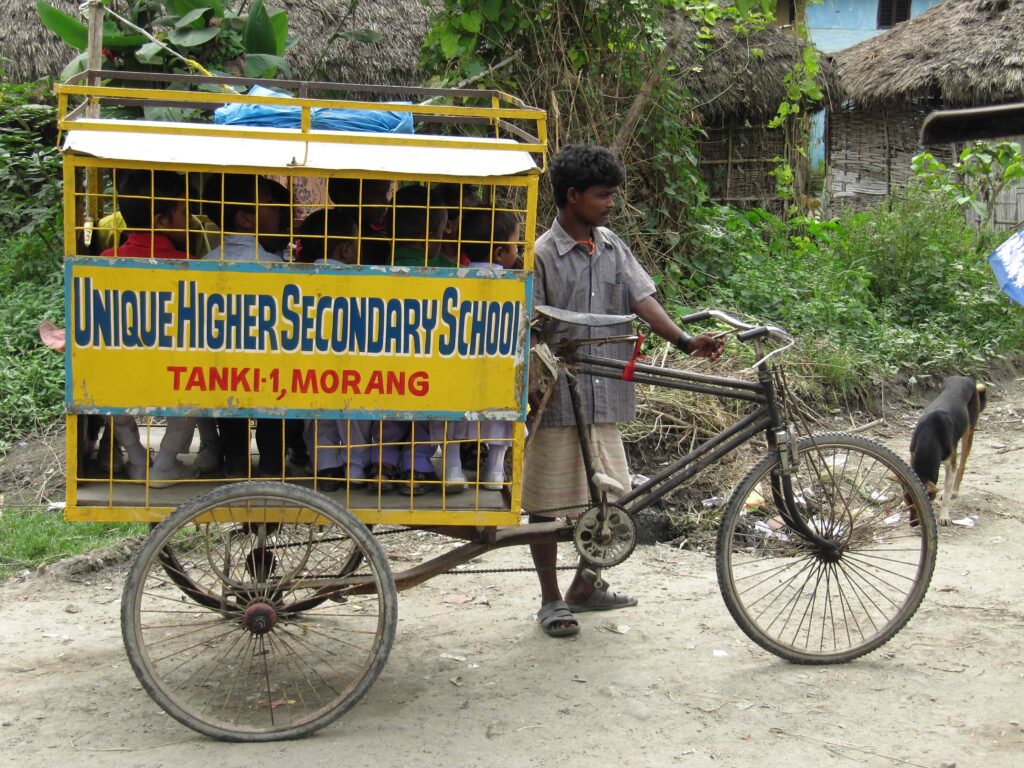
When I lived in Nepal, around 2010, I saw a rickshaw school bus, and the image stayed with me all these years, making me to I imagine a pedal-bus for adults. First because, in the spirit of self-reliance, it’s a technology that can easily be replicated in any village, even without 3D printers, unlike electric buses or trains. You might ask, why not just give everyone a bicycle? That takes us back to the problem of resources and waste. If the village has three thousand adults, and each gets a bicycle….
Of course, while one person can ride a rickshaw full of children, it might be another matter for a bus full of adults. But if the driving-system allows for five or six pedallers, then it becomes possible. Five people driving a single bus might seem wasteful, but in a world without capitalism a lot of people will have a lot of idle time. Colonialists kept calling Africans ‘lazy’, but I read between the lines to see that people loved to idle under trees and drink beer because they didn’t have bosses stressing them with work. So a lot of people might need something to do. Besides, other passengers could also double as the drivers.
The pedal-tractor
A thing that bugs me is how much resources we put to figure out ways to go to Mars, or to make the next shiny iPhone, and yet essential technologies are ignored. To increase food production, small-scale farmers need tools that are as cheap as hand-hoes, like this tractor that you pedal to plough. No need for oxen, or huge expensive engines.
Bio-photovaltic solar panels
The solar-panel as we know it might give us a clean energy revolution. It might replace the grid and help end the use of fossil fuels, but there is a chance it will all come from a handful of profit minded corporations, and in the end we will just recycle a lot of today’s problems, the biggest being dependency. In Uganda, electricity is produced locally from hydro-power stations. If solar-panels flood the country and every house has them on the roof, and yet all of it is imported, well, the hydro-power stations will shut down and all of the country’s energy will be imported.
When I started daydreaming of biophovotaltic panels, using photosynthesis to generate electricity, I thought it was science fantasy. But I did a casual search and was stunned to learn it is an actual science. One researcher claims to have made a biopanel that could be made by anyone, anywhere, for about $50 per square meter. If we get that kind of solar technology, then the true revolution will begin! But what I really dream about is a plant, or plant extract, that can continue generating electricity even after the sun has gone down, using the energy they stored after photosynthesis.
This is the film, and I need your support to make it. I feel winded after this long rant. Here is the link to the donation page.
References
Okot p’Bitek’s quotation is from ‘Religion of the Central Luo’ in Lawino’s People: The Acholi of Uganda by Tim Allen (ed). Berlin: LIT Verlag, 2018.
Hesketh Bell’s quotation is from this article, ‘The Moving Frontier of British Imperialism in Northern Uganda 1898-1919’ by Barber, J. P. in The Uganda Journal, Volume 29, Part 1, published in 1965. pp.27-43
For more on the decentralised governance and justice systems of precolonial Acholi, read John JaraMogi Oloya’s PhD, ‘How did governance in Acholi dovetail with violence?’